Showing posts with label Blessed Sacrament. Show all posts

Saturday, May 18, 2013

HOLY MASS FOR THE SOLEMNITY OF CORPUS CHRISTI, HOMILY OF HIS HOLINESS BENEDICT XVI Basilica of Saint John Lateran Thursday, 7 June 2012


Dear Brothers and Sisters,

This evening I would like to meditate with you on two interconnected aspects of the Eucharistic Mystery: worship of the Eucharist and its sacred nature. It is important to reflect on them once again to preserve them from incomplete visions of the Mystery itself, such as those encountered in the recent past.
First of all, a reflection on the importance of Eucharistic worship and, in particular, adoration of the Blessed Sacrament. We shall experience it this evening, after Mass, before the procession, during it and at its conclusion. A unilateral interpretation of the Second Vatican Council penalized this dimension, in practice
restricting the Eucharist to the moment of its celebration. Indeed it was very important to recognize the centrality of the celebration in which the Lord summons his people, gathers it round the dual table of the Word and of the Bread of life, nourishes and unites it with himself in the offering of the Sacrifice.

Of course, this evaluation of the liturgical assembly in which the Lord works his mystery of communion and brings it about still applies; but it must be put back into the proper balance. In fact — as often happens — in order to emphasize one aspect one ends by sacrificing another. In this case the correct accentuation of the celebration of the Eucharist has been to the detriment of adoration as an act of faith and prayer addressed to the Lord Jesus, really present in the Sacrament of the Altar.

This imbalance has also had repercussions on the spiritual life of the faithful. In fact, by concentrating the entire relationship with the Eucharistic Jesus in the sole moment of Holy Mass one risks emptying the rest of existential time and space of his presence. This makes ever less perceptible the meaning of Jesus’ constant presence in our midst and with us, a presence that is tangible, close, in our homes, as the “beating Heart” of the city, of the country, and of the area, with its various expressions and activities. The sacrament of Christ’s Charity must permeate the whole of daily life.

Actually it is wrong to set celebration and adoration against each other, as if they were competing. Exactly the opposite is true: worship of the Blessed Sacrament is, as it were, the spiritual “context” in which the community can celebrate the Eucharist well and in truth. Only if it is preceded, accompanied and followed by this inner attitude of faith and adoration can the liturgical action express its full meaning and value. The encounter with Jesus in Holy Mass is truly and fully brought about when the community can recognize that in the Sacrament he dwells in his house, waits for us, invites us to his table, then, after the assembly is dismissed, stays with us, with his discreet and silent presence, and accompanies us with his intercession, continuing to gather our spiritual sacrifices and offer them to the Father.

In this regard I am pleased to highlight the experience we shall be having together this evening too. At the moment of Adoration, we are all equal, kneeling before the Sacrament of Love. The common priesthood and the ministerial priesthood are brought together in Eucharistic worship. It is a very beautiful and significant experience which we have had several times in St Peter’s Basilica, and also in the unforgettable Vigils with young people — I recall, for example, those in Cologne, London, Zagreb and Madrid. It is clear to all that these moments of Eucharistic Vigil prepare for the celebration of the Holy Mass, they prepare hearts for the encounter so that it will be more fruitful.

To be all together in prolonged silence before the Lord present in his Sacrament is one of the most genuine experiences of our being Church, which is accompanied complementarily by the celebration of the Eucharist, by listening to the word of God, by singing and by approaching the table of the Bread of Life together. Communion and contemplation cannot be separated, they go hand in hand. If I am truly to communicate with another person I must know him, I must be able to be in silence close to him, to listen to him and look at him lovingly. True love and true friendship are always nourished by the reciprocity of looks, of intense, eloquent silences full of respect and veneration, so that the encounter may be lived profoundly and personally rather than superficially. And, unfortunately, if this dimension is lacking, sacramental communion itself may become a superficial gesture on our part.

Instead, in true communion, prepared for by the conversation of prayer and of life, we can address words of confidence to the Lord, such as those which rang out just now in the Responsorial Psalm: “O Lord, I am your servant; I am your servant, the son of your handmaid. / You have loosed my bonds./ I will offer to you the sacrifice of thanksgiving /and call on the name of the Lord” (Ps 116[115]:16-17).

I would now like to move on briefly to the second aspect: the sacred nature of the Eucharist. Here too so we have heard in the recent past of a certain misunderstanding of the authentic message of Sacred Scripture. The Christian newness with regard to worship has been influenced by a certain secularist mentality of the 1960s and 70s. It is true, and this is still the case, that the centre of worship is now no longer in the ancient rites and sacrifices, but in Christ himself, in his person, in his life, in his Paschal Mystery. However it must not be concluded from this fundamental innovation that the sacred no longer exists, but rather that it has found fulfilment in Jesus Christ, divine Love incarnate.

The Letter to the Hebrews, which we heard this evening in the Second Reading, speaks to us precisely of the newness of the priesthood of Christ, “high priest of the good things that have come” (Heb 9:11), but does not say that the priesthood is finished. Christ “is the mediator of a new covenant” (Heb 9:15), established in his blood which purifies our “conscience from dead works” (Heb 9:14). He did not abolish the sacred but brought it to fulfillment, inaugurating a new form of worship, which is indeed fully spiritual but which, however, as long as we are journeying in time, still makes use of signs and rites, which will exist no longer only at the end, in the heavenly Jerusalem, where there will no longer be any temple (cf. Rev 21:22). Thanks to Christ, the sacred is truer, more intense and, as happens with the Commandments, also more demanding! Ritual observance does not suffice but purification of the heart and the involvement of life is required.
I would also like to stress that the sacred has an educational function and its disappearance inevitably impoverishes culture and especially the formation of the new generations. If, for example, in the name of a faith that is secularized and no longer in need of sacred signs, these Corpus Christiprocessions through the city were to be abolished, the spiritual profile of Rome would be “flattened out”, and our personal and community awareness would be weakened.

Or let us think of a mother or father who in the name of a desacralized faith, deprived their children of all religious rituals: in reality they would end by giving a free hand to the many substitutes that exist in the consumer society, to other rites and other signs that could more easily become idols.

God, our Father, did not do this with humanity: he sent his Son into the world not to abolish, but to give fulfilment also to the sacred. At the height of this mission, at the Last Supper, Jesus instituted the Sacrament of his Body and his Blood, the Memorial of his Paschal Sacrifice. By so doing he replaced the ancient sacrifices with himself, but he did so in a rite which he commanded the Apostles to perpetuate, as a supreme sign of the true Sacred One who is he himself. With this faith, dear brothers and sisters, let us celebrate the Eucharistic Mystery today and every day and adore it as the centre of our life and the heart of the world. Amen.

Saturday, August 11, 2012

MIRAE CARITATIS (On the Holy Eucharist) Pope Leo XIII - Conclusion

19. To conclude, we gladly acknowledge that it has been a cause of no small joy to us that during these last years a renewal of love and devotion towards the Sacrament of the Eucharist has, as it seems, begun to show itself in the hearts of the faithful; a fact which encourages us to hope for better times and a more favourable state of affairs. Many and varied, as we said at the commencement, are the expedients which an inventive piety has devised; and worthy of special mention are the confraternities instituted either with the object of carrying out the Eucharistic ritual with greater splendour, or for the perpetual adoration of the venerable Sacrament by day and night, or for the purpose of making reparation for the blasphemies and insults of which it is the object. But neither We nor you, Venerable Brethren, can allow ourselves to rest satisfied with what has hitherto been done; for there remain many things which must be further developed or begun anew, to the end that this most divine of gifts this greatest of mysteries, may be better understood and more worthily honoured and revered, even by those who already take their part in the religious services of the Church.

Wherefore, works of this kind which have been already set on foot must be ever more zealously promoted; old undertakings must be revived wherever perchance they may have fallen into decay; for instance, Confraternities of the holy Eucharist, intercessory prayers before the blessed Sacrament exposed for the veneration of the faithful, solemn processions, devout visits to God's tabernacle, and other holy and salutary practices of some kind; nothing must be omitted which a prudent piety may suggest as suitable. But the chief aim of our efforts must be that the frequent reception of the Eucharist may be everywhere revived among Catholic peoples. For this is the lesson which is taught us by the example, already referred to, of the primitive Church, by the decrees of Councils, by the authority of the Fathers and of the holy men in all ages. 

For the soul, like the body, needs frequent nourishment; and the holy Eucharist provides that food which is best adapted to the support of its life. Accordingly all hostile prejudices, those vain fears to which so many yield, and their specious excuses from abstaining from the Eucharist, must be resolutely put aside; for there is question here of a gift than which none other can be more serviceable to the faithful people, either for the redeeming of time from the tyranny of anxious cares concerning perishable things, or for the renewal of the Christian spirit and perseverance therein. To this end the exhortations and example of all those who occupy a prominent position will powerfully contribute, but most especially the resourceful and diligent zeal of the clergy. For priests, to whom Christ our Redeemer entrusted the office of consecrating and dispensing the mystery of His Body and Blood, can assuredly make no better return for the honour which has been conferred upon them, than by promoting with all their might the glory of his Eucharist, and by inviting and drawing the hearts of men to the health-giving springs of this great Sacrament and Sacrifice, seconding hereby the longings of His most Sacred Heart.

20. May God grant that thus, in accordance with Our earnest desire, the excellent fruits of the Eucharist may daily manifest themselves in greater abundance, to the happy increase of faith, hope, and charity, and of ail Christian virtues; and may this turn to the recovery and advantage of the whole body politic; and may the wisdom of God's most provident charity, Who instituted this mystery for all time "for the life of the world," shine forth with an ever brighter sight.

21. Encouraged by such hopes as these, Venerable Brethren, We, as a presage of the divine liberality and as a pledge of our own charity, most lovingly bestow on each of you, and on the clergy and flock committed to the care of each, our Apostolic Benediction.

Given at Rome, at St. Peter's on the 28th day of May, being the Vigil of the Solemnity of Corpus Christi, in the year 1902, of Our Pontificate the five and twentieth.

LEO XIII

Wednesday, November 3, 2010

History of Benediction

It is easy to recognize in our ordinary Benediction service, the traces of two distinct elements. There is of course in the first place the direct veneration of the Blessed Sacrament, which appears in the exposition, blessing, "Tantum ergo", etc. But besides this we note the almost invariable presence of what at first sight seems an incongruous element, that of the litany of Loreto, or of popular hymns in honor of Our Lady. Tracing our present service back to its origin we find that these two features are derived from different sources. The idea of exposing the Blessed Sacrament for veneration in a monstrance appears to have been first evolved at the end of the thirteenth or the beginning of the fourteenth century. When the elevation of the Host at Mass was introduced in the early years of the thirteenth century, probably as a form of protest against the theological views of Peter the Chanter, the idea by degrees took firm hold of the popular mind that special virtue and merit were attached to the act of looking at the Blessed Sacrament. To such extremes did this prepossession go, that the seeing of the Host at the moment of the elevation was judged to be the most vital part of attendance at Mass. On certain churches in Spain a screen of black velvet was held up behind the altar in order that the priest's hands and the Host might be more easily seen from afar; in others strict injunctions were given to the thurifer that he should on no account allow the smoke of the thurible to obstruct the view of the Host. Furthermore, we read that when men were dying and were unable on account of vomiting or any other cause to receive Holy Viaticum, the Blessed Sacrament was brought to them and held up before them to look at. Indeed, a virtual prohibition of this practice stands to this day amongst the rubrics of the "Rituale Romanum."
 
Under the influence of this idea, the Blessed Sacrament in the processions which became common after the institution of the feast of Corpus Christi in 1246, came by degrees to be carried in transparent vessels, resembling our present monstrances. Moreover, a custom grew up, especially in Germany, of keeping the Blessed Sacrament continually exposed to view in churches. It was forbidden by many synods, but a sort of compromise was arrived at through the construction of the Sakramentshäuschen of which so many examples still exist in central Europe. These tabernacles, of great height and imposing appearance, were erected in the most conspicuous part of the church, and there the Blessed Sacrament was reserved in a monstrance behind a metal door of lattice-work which allowed a more or less free view of the interior. It was thus that the practice developed, though partly kept in check by synodal decrees, of adding solemnity to any function, even the Mass itself, by exposing the Blessed Sacrament during its continuance.
 

Turning now to our second element, we find that from the beginning of the thirteenth century, a custom prevailed among the confraternities and guilds which were established at that period in great numbers, of singing canticles in the evening of the day before a statue of Our Lady. These canticles were called Laude and were often composed in the vulgar tongue, becoming in the hands of such poets as the Franciscan Giacopone da Todi, one of the great popular influences which helped to develop a native Italian literature. Confraternities were formed for the express purpose of singing these canticles and their members were called Laudesi. It was such a company of Laudesi that brought together the seven holy founders who, in the first half of the thirteenth century, established the Order of Servites, or Servants of Mary. Although the laude hardly flourished outside Italy, where both the language and the character of the people lent themselves readily to the composition of innumerable canticles, the idea of an evening service of a popular character sung before the statue of Our Lady, spread throughout Europe.  In particular, the "Salve Regina", a special devotion of the Servites, Dominicans, Carmelites, and other orders, was consecrated by usage to this rite, and we find traces everywhere of its being sung, often by choirs of boys, for whom a special endowment was provided, as a separate evening service. In France, this service was commonly known as a Salut, in the Low Countries as the Lof, in England and Germany, simply as the Salve.
Now it seems certain that our present Benediction service has resulted from the general adoption of this evening singing of canticles before the statue of Our Lady, enhanced as it often came to be in the course of the sixteenth and seventeenth centuries by the exposition of the Blessed Sacrament, which as employed at first only as an adjunct to lend it additional solemnity. The blessing at the close seems to have been added simply because the custom gained ground of making the sign of the Cross over the people whenever the Blessed Sacrament was replaced in the tabernacle after a procession or after being carried to the sick or any kind of an exposition. But in the course of the seventeenth century, we find numberless bequests for Saluts in French wills, the items to be sung, often of a most miscellaneous character, being minutely specified, and among these the condition is frequently appended that the Blessed Sacrament should be exposed during the whole time of the Salut.

Reference:  http://www.newadvent.org/cathen/02465b.htm

Tuesday, November 2, 2010

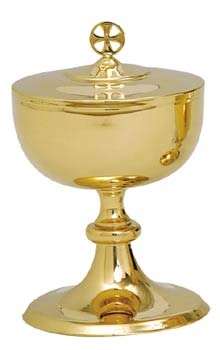
The Ciborium

A chalice-like vessel used to contain the Blessed Sacrament. Some derive it from the Latin word cibus, "food", because it is used to contain the Heavenly Bread: while others trace it to the Greek kirorion, "cup", because of the original shape of this Eucharistic receptacle. The term was also applied in early Christian times to the Canopy that surmounted and crowned the altar, but according to modern liturgical usage the word denotes exclusively the sacred vessel employed for the reservation of the Consecrated Species. At the present day two vessels are used to reserve the Blessed Sacrament: one, called a pyx, is a small round box and serves for carrying the Blessed Sacrament to the sick; the other, generally styled a ciborium, is used for distributing Holy Communion churches and for reserving the consecrated particles in the tabernacle. In shape the ciborium resembles a chalice but the cup or bowl is round rather than oblong, and provided with a conical cover surmounted by a cross or some other appropriate device. The bottom of the cup should be a little raised at the centre so that the last particles may be easily removed and the purification more conveniently performed. The material should be gold or silver (base metals are sometimes allowed), but the interior of the cup must be always lined with gold. The ciborium is not consecrated, but blessed by a bishop or some priest deputed by him, according to the form given in the Roman Ritual.  
 
While containing the Sacred Species it should be covered with small white veil of silk or cloth of gold, and may not be handled except by sacred ministers; when empty and purified it may be touched by all clerics (Cong. of Rites, Jan., 1907), and by lay persons if specially authorized. In Eastern Churches the paten commonly used for the distribution of Communion, and the Blessed Sacrament is reserved in gold or silver boxes covered with silk and suspended from the altar-canopy in accordance with ancient custom.


During the first three centuries the Blessed Eucharist was not generally reserved in churches owing to the danger of profanation and the persecutions, but the faithful sometimes kept the Sacred Species in Silver boxes in their homes for the purpose of receiving it at the time of death (St. Jerome, De Afr. Pers., I; Tertullian, On Prayer 14 etc.). In the fourth century there are evidences that it was reserved in churches, but only for the sick. In the fifth and sixth centuries reservation was more common, and the method adopted varied with time and place. The vessels which the Sacred Species was kept were called indiscriminately capsa, pyxis, cuppa, turris, columba, and ciborium, and were themselves preserved either in a chamber in the sacristy (secretarium), in a niche in the wall or pillar (ambry), under an altar, or in other places designated by the words diaconium, pastophorium, vestiarium, etc. Subsequently it became the practice to reserve the Blessed Sacrament in dove-shaped receptacles (columb) or in little towers (turres), the former being suspended by chains from the ciborium or canopy of the altar, and the latter being usually placed in the Armarium. In the sixteenth century the columbæ and the towers began to disappear, and gave way to the tabernacle and the custom which is now universal throughout the Western Church. . Ancient vessels of reservation may still be seen in the treasuries of continental cathedrals at Milan, Cologne, Rouen and elsewhere. 

From:  http://www.newadvent.org/cathen/03767a.htm