Showing posts with label Priests Vestments. Show all posts

Monday, September 19, 2011

Dominicae Cenae - On The Mystery And Worship Of The Eucharist - Part 12 (Section 2)


This subordination of the minister, of the celebrant, to the mysterium which has been entrusted to him by the Church for the good of the whole People of God, should also find expression in the observance of the liturgical requirements concerning the celebration of the holy Sacrifice. These refer, for example, to dress, in particular to the vestments worn by the celebrant. Circumstances have of course existed and continue to exist in which the prescriptions do not oblige. We have been greatly moved when reading books written by priests who had been prisoners in extermination camps, with descriptions of Eucharistic Celebrations without the above- mentioned rules, that is to say, without an altar and without vestments. But although in those conditions this was a proof of heroism and deserved profound admiration, nevertheless in normal conditions to ignore the liturgical directives can be interpreted as a lack of respect towards the Eucharist, dictated perhaps by individualism or by an absence of a critical sense concerning current opinions, or by a certain lack of a spirit of faith.

Upon all of us who, through the grace of God, are ministers of the Eucharist, there weighs a particular responsibility for the ideas and attitudes of our brothers and sisters who have been entrusted to our pastoral care. It is our vocation to nurture, above all by personal example, every healthy manifestation of worship towards Christ present and operative in that sacrament of love. May God preserve us from acting otherwise and weakening that worship by "becoming unaccustomed" to various manifestations and forms of eucharistic worship which express a perhaps "traditional" but healthy piety, and which express above all that "sense of the faith" possessed by the whole People of God, as the Second Vatican Council recalled.(70)
As I bring these considerations to an end, I would like to ask forgiveness-in my own name and in the name of all of you, venerable and dear brothers in the episcopate-for everything which, for whatever reason, through whatever human weakness, impatience or negligence, and also through the at times partial, one-sided and erroneous application of the directives of the Second Vatican Council, may have caused scandal and disturbance concerning the interpretation of the doctrine and the veneration due to this great sacrament. And I pray the Lord Jesus that in the future we may avoid in our manner of dealing with this sacred mystery anything which could weaken or disorient in any way the sense of reverence and love that exists in our faithful people.

May Christ Himself help us to follow the path of true renewal towards that fullness of life and of eucharistic worship whereby the Church is built up in that unity that she already possesses, and which she desires to bring to ever greater perfection for the glory of the living God and for the salvation of all humanity.

Tuesday, November 16, 2010

The Alb - Priests Vestments

The Alb is a white linen vestment with close fitting sleeves, reaching nearly to the ground and secured round the waist by a cincture. It has in the past been known by many various names: linea or tunica linea, from the material of which it is made; poderis, tunica talaris, or simply talaris, from the fact of its reaching to the feet (tali, ankles); camisia, from the shirt-like nature of the garment; alba, (white) from its colour; and finally, alba Romana.   Of these the name alba almost alone survives.

Another use of the word alb, commonly in the plural albæ (vestes), occurs in medieval writers. It refers to the white garments which the newly baptized assumed on Holy Saturday, and wore until Low Sunday, which was consequently known as dominica in albis (deponendis), the Sunday of the (laying aside of the) white garments.  From the usage mentioned, both Low Sunday and Trinity Sunday, together with the days preceding seem sometimes to have been called Albæ. Possibly our Whit-Sunday, the Sunday after the Pentecost baptisms, may derive its name from a similar practice. In this article we shall treat of the origin, symbolism, use, form, ornamentation, material, and colour of the alb.

It is impossible to speak positively about the origin of this vestment. Medieval liturgists, e.g. Rupert of Deutz, favoured the view that the Christian vestments in general were derived from those of the Jewish priesthood, and that the alb in particular represents the Kethonet, a white linen tunic of which we read in Exodus 28:39. But a white linen tunic also formed part of the ordinary attire of both Romans and Greeks under the Empire. The fact that a white linen tunic was a common feature of secular attire also makes it difficult to determine the epoch to which we must assign the introduction of our present alb as a distinctly liturgical garment. The word alba, indeed, meets us not infrequently in connection with ecclesiastical vesture in the first seven centuries.  

In the early centuries some sort of special white tunic was generally worn by priests under the chasuble, and that in course of time this came to be regarded as liturgical. A prayer mentioning "the tunic of chastity," which is assigned to the priest in the Stowe Missal, helps to confirm this view.  Before the time of Rabanus Maurus, who wrote his "De Clericorum Institutione" in 818, the alb had become an integral part of the priest's sacrificial attire. Rabanus describes it fully (P.L., CVII, 306). It was to be put on after the amice. It was made, he says, of white linen, to symbolize the self-denial and chastity befitting a priest. It hung down to the ankles, to remind him that he was bound to practice good works to his life's end. At present the priest in putting on the alb says this prayer: "Purify me, O Lord, from all stain, and cleanse my heart, that washed in the Blood of the Lamb I may enjoy eternal delights."

As regards the use of the alb, the practice has varied from age to age. Until the middle of the twelfth century the alb was the vestment which all clerics wore when exercising their functions, and Rupert of Deutz mentions that, on great festivals, both in his own monastery and at Cluny, not only those who officiated in the sanctuary, but all the monks in their stalls wore albs. The alb was also worn at this period in all religious functions, e.g. in taking Communion to the sick, or when assisting at a synod. Since the twelfth century, however, the cotta or surplice has gradually been substituted for the alb in the case of all clerics save those in greater orders, i.e. subdeacon, deacon, priest, and bishop. At present the alb is little used outside the time of Mass. At all other functions it is permissible for priests to wear a surplice.

Beyond a certain enlargement or contraction as to lateral dimensions, no great change has taken place in the shape of the alb since the ninth century. In the Middle Ages  the vestment seems to have been made to fit pretty closely around the waist, but it broadened out below so that the lower edge, in some cases, measured as much as five yards, or more, in circumference. No doubt in practice it was pleated and made to hang tolerably close to the figure. Towards the end of the sixteenth century again, when voluminous garments were everywhere in vogue, St. Charles Borromeo prescribed a circumference of over seven yards for the bottom of the alb. But his regulation, though approved, cannot be said to make a law for the Church at large.
Much greater diversity has been shown in the ornamentation of the alb. In the early ages we find the lower edge decorated with a border sometimes both rich and deep. Similar embroideries adorned the wrists and the caputium (head opening), i.e. the neck. The use of lace, though permitted, ought never to lose the character of a pure decoration. Albs, with lace reaching above the knees, are not, strictly speaking, en règle, though there is a special decree of 16 June, 1893, tolerating albs with lace below the cincture for canons at Mass, on solemn feast days. Formerly a decree of the Congregation of Rites prohibited any coloured lining behind the flounce, or cuffs, or lace with which the alb might be decorated, but a more recent decree (12 July, 1892) sanctioned the practice. In point of material the alb must be made of linen (woven of flax or hemp); hence cotton or wool are forbidden. The colour must now be white. Moreover, the use of silk and colours instead of albs of white linen has lasted on in isolated instances, both in East and West, down to our own days. It may be added that, like other sacerdotal vestments, the alb needs to be blessed before use.

Monday, November 15, 2010

Priests Vestments - The Cincture

The Cincture is a liturgical vestment, worn encircling the body around or above the waist. In the Roman Catholic Church, the cincture is a long, rope-like cord with tassled or knotted ends, tied around the waist outside the alb. The colour may be white, or may vary according to the colour of the liturgical season.
As deacons tie their stoles on the right, they often fasten the cincture on the left nstead. Priests and bishops usually have the knot of their cincture in front of them; the loose ends are often passed around the stole and tucked through the waist of the cincture at each side. When the cincture is tied in the front and the ends draped on either side, it is called a Roman Knot. Besides its functional role in securing the alb and stole, the cincture bears a symbolic role, signifying chastity and purity.

The material of the cincture is preferably flax or hemp, but wool and silk — the latter especially for occasions of solemnity — are not prohibited. This material is woven into a cord, and the ends are usually decorated with tassels, By way of ornament strands of gold and silver thread are sometimes introduced, particularly in the tassels at the extremities. The prayer now recited by the priest in putting on the cincture, "Gird me, O Lord, with the girdle of purity", etc., strongly suggests that this vestment should be regarded as typical of priestly chastity. Like the other Mass vestments, the cincture requires to be blessed before use.

Sunday, November 14, 2010

The Stole - Priests Vestments

The Stole is a liturgical vestment of the Catholic Church as well as other Christian churches. It consists of a band of colored cloth, formerly usually of silk, about seven and a half to nine feet long and three to four inches wide, whose ends may be straight or may broaden out. The center of the stole is worn around the back of the neck and the two ends hang down parallel to each other in front, either attached to each other or hanging loose. The stole is almost always decorated in some way, usually with a cross or some other significant religious design. It is often decorated with contrasting galloons (ornamental trim) and fringe is usually applied to the ends of the stole following Numbers 15:38-39. A piece of white linen or lace may be stitched onto the back of the collar as a sweat guard which can be replaced more cheaply than buying a new stole.

The word stole derives via the Latin stola, from the Greek στολή (stolē), "garment", originally "array" or "equipment".  The stole was originally a kind of shawl that covered the shoulders and fell down in front of the body;  After being adopted by the Church of Rome about the seventh century (the stole having also been adopted in other locales prior to this), the stole became gradually narrower and so richly ornamented that it developed into a mark of dignity. Nowadays, the stole is usually wider and can be made from a wide variety of material.

There are many theories as to the "ancestry" of the stole. Some say it came from the tallit (Jewish prayer mantle), because it is very similar to the present usage (as in the Priest who puts it on when he leads in prayer) but this theory is no longer regarded much today. More popular is the theory that the stole originated from a kind of liturgical napkin called an orarium (cf. orarion) very similar to the sudarium. In fact, in many places the stole is called the orarium. Therefore it is linked to the napkin used by Christ in washing the feet of his disciples, and is a fitting symbol of the yoke of Christ, the yoke of service.

Together with the cincture and the now mostly defunct maniple, the stole symbolizes the bonds and fetters with which Jesus was bound during his Passion; it is usually ornamented with a cross. Another version is that the stole denotes the duty to spread the Word of God.

The liturgical colors used for the stole and the other vestments in the Roman Catholic Church are indicated in the General Instruction of the Roman Missal, 346. They are colored white in the seasons of Easter and Christmas and on feasts that are not of martyrdom; red on Palm Sunday, Good Friday and Pentecost Sunday, and on feasts of martyred saints; green in Ordinary Time (between Christmastide and Lent and between Eastertide and Advent). Violet (often confused with purple) is the color for Advent and Lent, and may be used in Masses for the dead. Where it is customary, rose (pink) may be used for the third Sunday in Advent (the pink candle in the Advent wreath) and the fourth Sunday in Lent, which are known respectively, because of the first word of the Introit, as Gaudete Sunday and Laetare Sunday; these Latin words mean "Rejoice", and the change of color symbolizes, as it were, a "break" in the gloom of penance during the violet seasons. Similarly, black may be used, where customary, in Masses for the dead. However, Episcopal Conferences may, with the consent of the Holy See, adapt these rules to national traditions, as, for instance, in countries where white is the color of mourning.

Saturday, November 13, 2010

The Amice - Priests Vestments

The Amice is a liturgical vestment used mainly in the Roman Catholic Church. It consists of a white cloth connected to two long ribbon-like attachments, by which it is fastened around the shoulders of the priest. Before the liturgical reforms of 1972, its use was mandatory for all Roman Catholic Masses, but it is only required today if the alb does not cover the priest's ordinary clothing. Many priests choose to wear the amice for reasons of tradition or to prevent damage to their other vestments due to perspiration.

Certain mendicant Orders, such as the Dominicans and Franciscans, and some other orders with hooded habits, often donned the amice over the raised hood. The priest, or minister, then fastened the ribbons - crossed at the chest - behind his chest. The alb was donned over the hood/amice, and fastened. The hood/amice could then be retracted neatly around the collar.

In several Mediaeval uses, such as the Sarum Rite, the amice bore a broad stiff band of brocade or other decoration, giving the impression of a high collar. These were called apparelled amices. This practice was abandoned at Rome at about the end of the 15th century, but continued in other parts of Europe until much later. By 1907, however, the practice was no longer tolerated in Roman Catholic liturgy, but still exists within many Anglican communities.

Curiously enough, this collar-like amice spread to the Armenian Church, where is retained as a normal part of the priestly vestments among the Armenian Orthodox, who call it varkasWhile donning the amice, the priest first drapes the amice over his head (as with a hood), then lowers it to his neck, tying it around his torso. During this action he prays a short prayer asking God to clothe him with the "helmet of salvation".

Thursday, November 11, 2010

The Chasuble - Priests Vestments

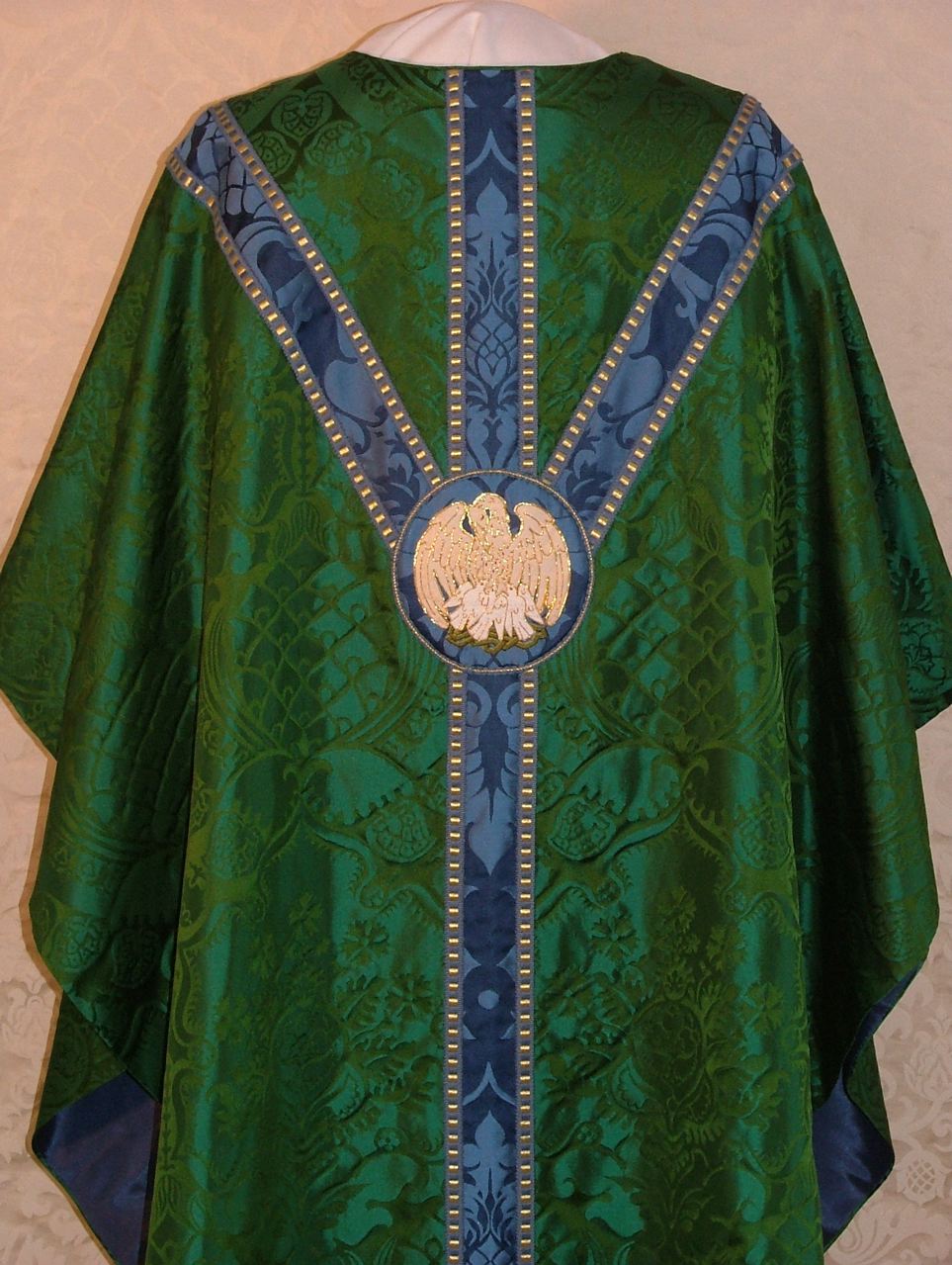
The Chasuble is the outermost liturgical vestment worn by clergy for the celebration of the Eucharist in Western-tradition Christian Churches that use full vestments, primarily in the Roman Catholic, Anglican and Lutheran churches, as well as in some parts of the United Methodist Church. In the Eastern Churches of Byzantine Rite, the equivalent vestment is the phelonion.

"The vestment proper to the priest celebrant at Mass and other sacred actions directly connected with Mass is, unless otherwise indicated, the chasuble, worn over the alb and stole" (General Instruction of the Roman Missal, 337). Like the stole, it is normally of the liturgical colour of the Mass being celebrated.
The chasuble originated as a sort of conical poncho, called in Latin a "casula" or "little house," that was the common outer traveling garment in the late Roman Empire. It was simply a roughly oval piece of cloth, with a round hole in the middle through which to pass the head, that fell below the knees on all sides. It had to be gathered up on the arms to allow the arms to be used freely.

As the casula became a liturgical garment in the West, it was folded up from the sides. Strings were sometimes used to assist in this task, and the deacon could help the priest in folding up the sides of the vestment. Beginning in the thirteenth century, there was a tendency to shorten the sides a little, as can be noticed in the illustration here of a fifteenth-century chasuble. In the course of that fifteenth century and the following century, the chasuble took something like the modern form, in which the sides of the vestment no longer reach to the ankle but only, at most, to the wrist, making folding unnecessary.

At the end of sixteenth century the chasuble, though still quite ample and covering a little of the arms, had become less similar to its traditional shape than to that which prevailed in the nineteenth and early twentieth centuries, when the chasuble was reduced to a broad scapular, leaving the whole of the arms quite free, and was shortened also in front and back. To make it easier for the priest to join his hands when wearing a chasuble of stiff (lined and heavily embroidered) material, the front was cut away further, giving it the distinctive shape often called "fiddleback". Complex decoration schemes were often used on chasubles of scapular form, especially the back, incorporating the image of the Christian cross or of a saint; and rich materials such as silk, cloth of gold or brocade were employed, especially in chasubles reserved for major celebrations.

In the twentieth century, there was a tendency to return to an earlier, more ample, form of the chasuble, sometimes called "Gothic", as distinguished from the "Roman" scapular form. This aroused some opposition, as a result of which the Sacred Congregation of Rites issued on 9 December 1925 a decree against it, which it explicitly revoked with the declaration Circa dubium de forma paramentorum of 20 August 1957, leaving the matter to the prudent judgement of local Ordinaries. There exists a photograph of Pope Pius XI wearing the more ample chasuble while celebrating Mass in Saint Peter's Basilica as early as 19 March 1930.

After the Second Vatican Council the more ample form became the most usually seen form of the chasuble, and the directions of the GIRM quoted above indicate that the beauty should come from its drapery and form rather than elaborate decoration ("fiddleback" vestments were often extremely heavily embroidered or painted with detailed decorations or whole scenes depicted). Hence, the prevalence today of chasubles that reach almost to the ankles, and to the wrists, and decorated with relatively simple symbols or bands and orphreys.

Some see a preference for the "fiddleback" as a sign of traditionalism or even rebellion against the reforms of the Second Vatican Council. However, some priests express simply on grounds of taste and comfort a preference for the scapular form, which continues to be included in mainstream catalogues of liturgical vestments; and other traditionalist priests prefer, for similar reasons, ampler chasubles of less stiff material.  The phelonion, the Byzantine Rite vestment that corresponds to the Latin Rite chasuble, is cut away from the front and not from the sides.