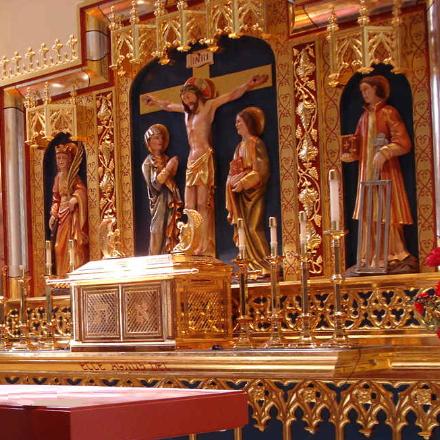
The following historical information is found, for instance, in the article The casing of the Holy Eucharist by the Secretary of the Congregation for the Clergy, Archbishop Mauro Piacenza, who also heads the Pontifical Commission for the Cultural Patrimony of the Catholic Church, in
30DAYS, No.6 Year XXIII – June 2005.
In early Christianity, priests and even lay people took bread consecrated at their Eucharistic celebrations to their homes, in order to give it to the sick and others unable to attend the celebration. But when the Edict of Milan ended persecution, the practice was established of keeping the Eucharist only in churches and no longer in people’s homes.
The preferred container then had the form of a (usually gold) dove within a (usually silver) tower. There is mention of a gift of these two vessels, both of gold and adorned with 250 white pearls, that the Emperor Constantine gave to Saint Peter’s Basilica in Rome, and of silver towers and golden doves given to particular churches by Pope Innocent I and Pope Hilarius.
The vessels were kept in a place called the "sacrarium" or "pastophorium" away from the central body of the church or were suspended by fine chains from the middle of the canopy (hence called a "ciborium" or bread store) above the altar of the church. Gian Lorenzo Bernini's 29-metre-high Baroque baldacchino over the main altar in today’s Saint Peter’s Basilica is at present the best-known such structure. Later, simpler vessels replaced to some extent the dove and the tower.
By the thirteenth century, the Eucharist was most often kept in a highly embellished cabinet inserted into the wall to the right or left of the altar. The Sanctuary Lamp indicated the Presence of Christ. This was a means of following the decree of the 1215 Fourth Lateran Council requiring that the reserved sacrament be kept in a locked receptacle.
In the late fourteenth century, special stone constructions for the Eucharistic bread began to be built, especially in northern Europe. In German and Netherlands churches of the period, such structures can still be seen: tall towers, known in German as Sakramentshäuser, in Dutch as sacramentstorens, usually placed to the north of the altar and often reaching almost to the ceiling. They were in use until the mid-nineteenth century.
In the early sixteenth century, Bishop Matteo Giberti ordered that, in diocese of Verona in Italy, the container case for the Eucharist should be placed on an altar. The custom spread through northern Italy. Saint Charles Borromeo, who became Archbishop of Milan, Italy in 1560, had the Sacrament moved from the sacristy to an altar (not the main altar) of his cathedral. The edition of the Roman Missal revised and promulgated by Pope Pius V in 1570 still did not envisage placing the tabernacle on an altar: it laid down instead that the altar card containing some of the principal prayers of the Mass should rest against a cross placed midway on the altar (Rubricae generales Missalis, XX - De Praeparatione Altaris, et Ornamentorum eius). However, in 1614 Pope Paul V imposed on the churches of his diocese of Rome the rule of putting the tabernacle on some altar. Reaction to Protestantism's denial of the reality and permanence of the Real Presence of Christ in the Eucharist then led to the spread of the placing of the tabernacle even on the high altar, so as to make it more evidently visible. Whether on the main altar of the church or in a special chapel, the tabernacle became more and more large and ornate, to the extent of dominating the altar.