John 13:1 says that Jesus "loved his own to the
end." This excerpt from St. Augustine's Treatise on the Gospel of
John (Tractate 84, 1-2 CCL 36, 536-538) speaks of Christ's laying down of
his life, handed over to us in the Eucharist, as the perfection of love.
It is used in the Roman Catholic
Church's Divine Office of Readings
Dear brethren, the Lord has marked
out for us the fullness of love that we ought to have for each other. He tells
us: No one has greater
love than the man who lays down his life for his friends. In these words, the Lord tells us what the perfect love we
should have for one another involves. John, the evangelist who recorded them,
draws the conclusion in one of his letters: As Christ laid down his life for us, so we too ought to lay
down our lives for our brothers. We should indeed love one another as he loved us, he who
laid down his life for us.
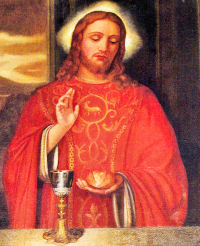
This is surely what we read in the Proverbs of Solomon: If you sit down to eat at the table of a ruler, observe carefully what is set before you; then stretch out your hand, knowing that you must provide the same kind of meal yourself. What is this ruler’s table if not the one at which we receive the body and blood of him who laid down his life for us? What does it mean to sit at this table if not to approach it with humility? What does it mean to observe carefully what is set before you if not to meditate devoutly on so great a gift? What does it mean to stretch out one’s hand, knowing that one must provide the same kind of meal oneself, if not what I have just said: as Christ laid down his life for us, so we in our turn ought to lay down our lives for our brothers? This is what the apostle Paul said: Christ suffered for us, leaving us an example, that we might follow in his footsteps.
This is what is meant by providing “the same kind of meal”. This is what the blessed martyrs did with such burning love. If we are to give true meaning to our celebration of their memorials, to our approaching the Lord’s table in the very banquet at which they were fed, we must, like them, provide “the same kind of meal”.
At this table of the Lord we do not commemorate the martyrs in the same way as we commemorate others who rest in peace. We do not pray for the martyrs as we pray for those others, rather, they pray for us, that we may follow in his footsteps. They practised the perfect love of which the Lord said there could be none greater. They provided “the same kind of meal” as they had themselves received at the Lord’s table.
This must not be understood as saying that we can be the Lord’s equals by bearing witness to him to the extent of shedding our blood. He had the power of laying down his life; we by contrast cannot choose the length of our lives, and we die even if it is against our will. He, by dying, destroyed death in himself; we are freed from death only in his death. His body did not see corruption; our body will see corruption and only then be clothed through him in incorruption at the end of the world. He needed no help from us in saving us; without him we can do nothing. He gave himself to us as the vine to the branches; apart from him we cannot have life.
Finally, even if brothers die for brothers, yet no martyr by shedding his blood brings forgiveness for the sins of his brothers, as Christ brought forgiveness to us. In this he gave us, not an example to imitate but a reason for rejoicing. Inasmuch, then, as they shed their blood for their brothers, the martyrs provided “the same kind of meal” as they had received at the Lord’s table. Let us then love one another as Christ also loved us and gave himself up for us.

