Showing posts with label The Holy Eucharist. Show all posts

Wednesday, March 27, 2013

The Sacred Character of the Eucharist - From Dominicae Cenae (Bl. John Paul II - 1980)

Sacred Character

8. Beginning with the Upper Room and Holy Thursday, the celebration of the Eucharist has a long history, a history as long as that of the Church. In the course of this history the secondary elements have undergone certain changes, but there has been no change in the essence of the "Mysterium" instituted by the Redeemer of the world at the Last Supper. The Second Vatican Council too brought alterations, as a result of which the present liturgy of the Mass is different in some ways from the one known before the Council. We do not intend to speak of these differences: It is better that we should now concentrate on what is essential and
immutable in the Eucharistic Liturgy.

There is a close link between this element of the Eucharist and its sacredness, that is to say, its being a holy and sacred action. Holy and sacred, because in it are the continual presence and action of Christ, "the Holy One" of God,(36) "anointed with the Holy Spirit,"(37) "consecrated by the Father"(38) to lay down His life of His own accord and to take it up again,(39) and the High Priest of the New Covenant.(40) For it is He who, represented by the celebrant, makes His entrance into the sanctuary and proclaims His Gospel. It is He who is "the offerer and the offered, the consecrator and the consecrated."(41) The Eucharist is a holy and sacred action, because it constitutes the sacred species, the Sancta sanctis, that is to say, the "holy things (Christ, the Holy One) given to the Holy," as all the Eastern liturgies sing at the moment when the eucharistic Bread is raised in order to invite the faithful to the Lord's Supper.

The sacredness of the Mass, therefore, is not a "sacralization," that is to say, something that man adds to Christ's action in the Upper Room, for the Holy Thursday supper was a sacred rite, a primary and constitutive liturgy, through which Christ, by pledging to give His life for us, Himself celebrated sacramentally the mystery of His passion and resurrection, the heart of every Mass. 

Our Masses, being derived from this
liturgy, possess of themselves a complete liturgical form, which, in spite of its variations in line with the families of rites, remains substantially the same. The sacred character of the Mass is a sacredness instituted by Christ. The words and actions of every priest, answered by the conscious active participation of the whole eucharistic assembly, echo the words and actions of Holy Thursday.

The priest offers the holy Sacrifice in persona Christi; this means more than offering "in the name of' or "in place of' Christ. In persona means in specific sacramental identification with "the eternal High Priest"(42) who is the author and principal subject of this sacrifice of His, a sacrifice in which, in truth, nobody can take His place. Only He-only Christ-was able and is always able to be the true and effective "expiation for our sins and...for the sins of the whole world."(43) Only His sacrifice-and no one else's-was able and is able to have a "propitiatory power" be fore God, the Trinity, and the transcendent holiness. Awareness of this reality throws a certain light on the character and significance of the priest celebrant who, by confecting the holy Sacrifice and acting "in persona Christi," is sacramentally (and ineffably) brought into that most profound sacredness, and made part of it, spiritually linking with it in turn all those participating in the eucharistic assembly.

This sacred rite, which is actuated in different liturgical forms, may lack some secondary elements, but it can in no way lack its essential sacred character and sacramentality, since these are willed by Christ and transmitted and regulated by the Church. Neither can this sacred rite be utilized for other ends. If separated from its distinctive sacrificial and sacramental nature, the Eucharistic Mystery simply ceases to be. It admits of no "profane" imitation, an imitation that would very easily (indeed regularly) become a profanation. This must always be remembered, perhaps above all in our time, when we see a tendency to do away with the distinction between the "sacred" and "profane," given the widespread tendency, at least in some places, to desacralize everything.

In view of this fact, the Church has a special duty to safeguard and strengthen the sacredness of the Eucharist. In our pluralistic and often deliberately secularized society, the living faith of the Christian
community-a faith always aware of its rights vis-a-vis those who do not share that faith-ensures respect for this sacredness. The duty to respect each person's faith is the complement of the natural and civil right to freedom of conscience and of religion.

The sacred character of the Eucharist has found and continues to find expression in the terminology of theology and the liturgy.(44) This sense of the objective sacred character of the Eucharistic Mystery is so much part of the faith of the People of God that their faith is enriched and strengthened by it.(45) Therefore the ministers of the Eucharist must, especially today, be illumined by the fullness of this living faith, and in its light they must understand and perform all that is part, by Christ's will and the will of His Church, of their priestly ministry.

Sunday, November 6, 2011

The Eucharist - The Medicine to heal our individualist Society - Pope Benedict XVI


.- The Eucharist is the medicine which can heal our individualist society, Pope Benedict XVI said in his midday Angelus address on Corpus Christi Sunday.

“In an increasingly individualistic culture in which Western societies are immersed - and which is tending to spread throughout the world - the Eucharist is a kind of ‘antidote’ which operates in the minds and hearts of believers and is continually sowing in them the logic of communion, of service, of sharing - in other words, the logic of the Gospel,” said Pope Benedict to pilgrims in St. Peter's Square on June 26.
Catholics believe that the bread and wine offered by Christ at the Last Supper literally became his body and blood - and that this same miracle is repeated by priests at every Mass since. Hence the name of today’s festivity – "Corpus Christi" Sunday or "Body of Christ" Sunday. 

“From the Eucharist,” observed the Pope, “the Risen Christ is truly present among his disciples and working with the power of the Holy Spirit. And in the following generations through the centuries, the Church, despite the limitations and human errors, has continued to be a force for communion throughout the world.”

The Catechism of the Catholic Church describes the Eucharist as the “source and summit” of Christian life. As the Pope bluntly put it today, “without the Eucharist, the Church simply does not exist.”
The Pope noted this belief in the centrality of the Eucharist has manifested itself throughout the history of the Church, beginning with the earliest Christian communities in Jerusalem who shared all possessions in common.

“From what came all this? From the Eucharist that is the Risen Christ, truly present among his disciples and working with the power of the Holy Spirit,” the Pope said. 
He then drew upon the example of the fourth century Abitene martyrs from North Africa who chose to die rather than deprive themselves of Sunday Mass in the face of Roman persecution. They proclaimed “Sine Dominico non possumus - without the ‘Dominicum’ - without the Sunday Eucharist, we cannot live.” 
Pope Benedict concluded by urging all pilgrims to turn to the Virgin Mary, the mother of Jesus, who was described by Pope John Paul II as the “Woman of the Eucharist.”

“At her school, our lives become fully ‘Eucharistic,’ open to God and others, capable of transforming evil into good with the power of love, striving to promote unity, fellowship, brotherhood.”

Tuesday, May 3, 2011

Mary Leads us to Eucharist - Message of Bl. Pope John Paul II in Czestochowa, Poland on 15th August 1996

Part 2.

Every Holy Mass makes present in an unbloody manner that unique and perfect sacrifice, offered by Christ on the Cross, in which Mary participated, joined in spirit with her suffering Son, lovingly consenting to his sacrifice and offering her own sorrow to the Father (cf. Lumen gentium, n. 58). Therefore when we celebrate the Eucharist, the memorial of Christ's passover, the memory of his Mother's suffering is also made alive and present, this Mother who, as an unsurpassable model, teaches the faithful to unite themselves more intimately to the sacrifice of her Son, the one Redeemer. Through spiritual communion with the sorrowful Mother of God, believers share in a special way in the paschal mystery and are opened to this extraordinary action of the Holy Spirit which produces a supernatural joy because of communion with the glorious Christ, on the example of the joy granted to Mary in the glory of heaven, as the first person to share in the fruits of the Redemption.

2. Mary and the Eucharist. The organizers of the 19th International Marian Congress in Jasna Gora proposed this as a theme for study and prayer. And it is a correct choice, especially in view of the International Eucharistic Congress that will be held next year in Krakow. In this way, just as Mary is present at the beginning of the mission of the Incarnate Word, and thereby at the origins of the Eucharist as well, the Marian Congress this year marks the start of the Church's spiritual preparation to make the Eucharistic Congress a fruitful experience. May these days bring you all close to her who—throughout her life in communion with her Son, not only by ties of blood but especially by love—is the most perfect Teacher of that love which enables us to be united in the deepest way with Christ in the mystery of his Eucharistic presence. Let Mary lead us to the Eucharist!


I ask all of you who are gathered in Jasna Gora for the Marian Congress to pray for the intentions of the Church and the world. As we give thanks for 20 centuries of Mary's protection of the Church, let us together ask her to lead believers towards an ever more perfect knowledge of the saving power of the Sacrifice of Christ, who is present in the Eucharist. Let us pray that the living experience of communion with Christ may bear fruits of zeal in the hearts of all Christians as they build up a communion of love among men. May the Mother of God lead us into the third millennium, united around the Word of God who was made flesh in her. I cordially bless you all.

Castel Gandolfo, 15 August 1996.

Friday, November 5, 2010

On Receiving Jesus in Holy Communion


"A person who is conscious of grave sin is not to celebrate Mass or receive the body of the Lord without previous sacramental confession unless there is a grave reason and there is no opportunity to confess; in this case the person is to remember the obligation to make an act of perfect contrition which includes the resolution of confessing as soon as possible." "A person who is to receive the Most Holy Eucharist is to abstain for at least one hour before holy communion from any food and drink, except for only water and medicine.”

Catholics may receive Communion during Mass or outside of Mass, but "a person who has already received the Most Holy Eucharist can receive it a second time on the same day only within the eucharistic celebration in which the person participates", except as Viaticum (Code of Canon Law, canon 917).

In the Western Church, "the administration of the Most Holy Eucharist to children requires that they have sufficient knowledge and careful preparation so that they understand the mystery of Christ according to their capacity and are able to receive the body of Christ with faith and devotion. The Most Holy Eucharist, however, can be administered to children in danger of death if they can distinguish the body of Christ from ordinary food and receive communion reverently" (Code of Canon Law, canon 913).

In the Eastern Catholic Churches, the Eucharist is administered to infants immediately after Baptism and Confirmation (Chrismation).   Holy Communion may be received under one kind (the Sacred Host alone), or under both kinds (both the Sacred Host and the Precious Blood). "Holy Communion has a fuller form as a sign when it is distributed under both kinds. For in this form the sign of the eucharistic banquet is more clearly evident and clear expression is given to the divine will by which the new and eternal Covenant is ratified in the Blood of the Lord, as also the relationship between the Eucharistic banquet and the eschatological banquet in the Father's Kingdom... (However,) Christ, whole and entire, and the true Sacrament, is received even under only one species, and consequently that as far as the effects are concerned, those who receive under only one species are not deprived of any of the grace that is necessary for salvation" (General Instruction of the Roman Missal, 281-282).

"The Diocesan Bishop is given the faculty to permit Communion under both kinds whenever it may seem appropriate to the priest to whom, as its own shepherd, a community has been entrusted, provided that the faithful have been well instructed and there is no danger of profanation of the Sacrament or of the rite's becoming difficult because of the large number of participants or some other reason" (General Instruction of the Roman Missal, 283).

In Eastern Catholic Churches the Eucharist is always received under both species (bread and wine), as was done at Mass also in the West until the opposite custom came into use, beginning in about the twelfth century.

With the change from receiving the Eucharist under both kinds to receiving under the form of bread alone, it also became customary in the West to receive the Host placed directly on the tongue, rather than on the hand, but this was prescribed neither by the Roman Missal nor by the Code of Canon Law. Since the late twentieth century many Episcopal Conferences allow communicants (at their personal discretion) to receive the Host on the hand, except when Communion is distributed by intinction (partly dipping the Host in the Chalice before distributing it).

The General Instruction of the Roman Missal, 118 mentions a "Communion-plate for the Communion of the faithful", distinct from the paten, to prevent the Host or fragments of it falling on the ground.


Reference:  http://en.wikipedia.org/wiki/Eucharist_in_the_Catholic_Church

Tuesday, November 2, 2010

Interceding for Others


When we go before Jesus in the Blessed Sacrament we represent the one in the world who is in most need of God’s Mercy." We "Stand in behalf of the one in the world who does not know Christ and who is farthest away from God and we bring down upon their soul the Precious Blood of The Lamb."

- Pope John Paul II

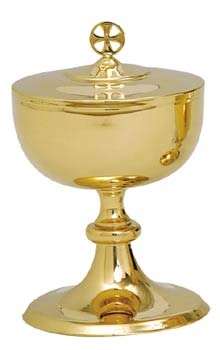
The Ciborium

A chalice-like vessel used to contain the Blessed Sacrament. Some derive it from the Latin word cibus, "food", because it is used to contain the Heavenly Bread: while others trace it to the Greek kirorion, "cup", because of the original shape of this Eucharistic receptacle. The term was also applied in early Christian times to the Canopy that surmounted and crowned the altar, but according to modern liturgical usage the word denotes exclusively the sacred vessel employed for the reservation of the Consecrated Species. At the present day two vessels are used to reserve the Blessed Sacrament: one, called a pyx, is a small round box and serves for carrying the Blessed Sacrament to the sick; the other, generally styled a ciborium, is used for distributing Holy Communion churches and for reserving the consecrated particles in the tabernacle. In shape the ciborium resembles a chalice but the cup or bowl is round rather than oblong, and provided with a conical cover surmounted by a cross or some other appropriate device. The bottom of the cup should be a little raised at the centre so that the last particles may be easily removed and the purification more conveniently performed. The material should be gold or silver (base metals are sometimes allowed), but the interior of the cup must be always lined with gold. The ciborium is not consecrated, but blessed by a bishop or some priest deputed by him, according to the form given in the Roman Ritual.  
 
While containing the Sacred Species it should be covered with small white veil of silk or cloth of gold, and may not be handled except by sacred ministers; when empty and purified it may be touched by all clerics (Cong. of Rites, Jan., 1907), and by lay persons if specially authorized. In Eastern Churches the paten commonly used for the distribution of Communion, and the Blessed Sacrament is reserved in gold or silver boxes covered with silk and suspended from the altar-canopy in accordance with ancient custom.


During the first three centuries the Blessed Eucharist was not generally reserved in churches owing to the danger of profanation and the persecutions, but the faithful sometimes kept the Sacred Species in Silver boxes in their homes for the purpose of receiving it at the time of death (St. Jerome, De Afr. Pers., I; Tertullian, On Prayer 14 etc.). In the fourth century there are evidences that it was reserved in churches, but only for the sick. In the fifth and sixth centuries reservation was more common, and the method adopted varied with time and place. The vessels which the Sacred Species was kept were called indiscriminately capsa, pyxis, cuppa, turris, columba, and ciborium, and were themselves preserved either in a chamber in the sacristy (secretarium), in a niche in the wall or pillar (ambry), under an altar, or in other places designated by the words diaconium, pastophorium, vestiarium, etc. Subsequently it became the practice to reserve the Blessed Sacrament in dove-shaped receptacles (columb) or in little towers (turres), the former being suspended by chains from the ciborium or canopy of the altar, and the latter being usually placed in the Armarium. In the sixteenth century the columbæ and the towers began to disappear, and gave way to the tabernacle and the custom which is now universal throughout the Western Church. . Ancient vessels of reservation may still be seen in the treasuries of continental cathedrals at Milan, Cologne, Rouen and elsewhere. 

From:  http://www.newadvent.org/cathen/03767a.htm

Sunday, October 31, 2010

Love the Holy Mass - St. Josemaria Escriva

From the writings of St. Josemaria Escriva de Balaguer
Christ is passing by...The Eucharist, mystery of faith and love > Chap. 9

A man who fails to love the Mass fails to love Christ. We must make an effort to "live" the Mass with calm and serenity, with devotion and affection. Those who love acquire a finesse, a sensitivity of soul that makes them notice details that are sometimes very small, but that are important because they express the love of a passionate heart. This is how we should attend the holy Mass. And this is why I have always suspected that those who want the Mass to be over quickly show, with this insensitive attitude, that they have not yet realized what the sacrifice of the altar means.

If we love Christ, who offers himself for us, we will feel compelled to find a few minutes after Mass for an intimate personal thanksgiving, which will prolong in the silence of our hearts that other thanksgiving which is the Eucharist. How are we to approach him, what are we to say, how should we behave?

Christian life is not made up of rigid norms, because the Holy Spirit does not guide souls collectively, but inspires each one with resolutions, inspirations and affections that will help it to recognize and fulfil the will of the Father. Still, I feel that, on many occasions, the central theme of our conversation with Christ, in our thanksgiving after holy Mass, can be the consideration that our Lord is our king, physician, teacher and friend.

Saturday, October 30, 2010

The Tabernacle - History

The following historical information is found, for instance, in the article The casing of the Holy Eucharist by the Secretary of the Congregation for the Clergy, Archbishop Mauro Piacenza, who also heads the Pontifical Commission for the Cultural Patrimony of the Catholic Church, in 30DAYS, No.6 Year XXIII – June 2005.

In early Christianity, priests and even lay people took bread consecrated at their Eucharistic celebrations to their homes, in order to give it to the sick and others unable to attend the celebration. But when the Edict of Milan ended persecution, the practice was established of keeping the Eucharist only in churches and no longer in people’s homes.

The preferred container then had the form of a (usually gold) dove within a (usually silver) tower. There is mention of a gift of these two vessels, both of gold and adorned with 250 white pearls, that the Emperor Constantine gave to Saint Peter’s Basilica in Rome, and of silver towers and golden doves given to particular churches by Pope Innocent I and Pope Hilarius.

The vessels were kept in a place called the "sacrarium" or "pastophorium" away from the central body of the church or were suspended by fine chains from the middle of the canopy (hence called a "ciborium" or bread store) above the altar of the church. Gian Lorenzo Bernini's 29-metre-high Baroque baldacchino over the main altar in today’s Saint Peter’s Basilica is at present the best-known such structure. Later, simpler vessels replaced to some extent the dove and the tower.

By the thirteenth century, the Eucharist was most often kept in a highly embellished cabinet inserted into the wall to the right or left of the altar. The Sanctuary Lamp indicated the Presence of Christ. This was a means of following the decree of the 1215 Fourth Lateran Council requiring that the reserved sacrament be kept in a locked receptacle.
In the late fourteenth century, special stone constructions for the Eucharistic bread began to be built, especially in northern Europe. In German and Netherlands churches of the period, such structures can still be seen: tall towers, known in German as Sakramentshäuser, in Dutch as sacramentstorens, usually placed to the north of the altar and often reaching almost to the ceiling. They were in use until the mid-nineteenth century.
In the early sixteenth century, Bishop Matteo Giberti ordered that, in diocese of Verona in Italy, the container case for the Eucharist should be placed on an altar. The custom spread through northern Italy. Saint Charles Borromeo, who became Archbishop of Milan, Italy in 1560, had the Sacrament moved from the sacristy to an altar (not the main altar) of his cathedral. The edition of the Roman Missal revised and promulgated by Pope Pius V in 1570 still did not envisage placing the tabernacle on an altar: it laid down instead that the altar card containing some of the principal prayers of the Mass should rest against a cross placed midway on the altar (Rubricae generales Missalis, XX - De Praeparatione Altaris, et Ornamentorum eius). However, in 1614 Pope Paul V imposed on the churches of his diocese of  Rome the rule of putting the tabernacle on some altar. Reaction to Protestantism's denial of the reality and permanence of the Real Presence of Christ in the Eucharist then led to the spread of the placing of the tabernacle even on the high altar, so as to make it more evidently visible. Whether on the main altar of the church or in a special chapel, the tabernacle became more and more large and ornate, to the extent of dominating the altar.

The Eucharist - Jesus with us

The Eucharist is Jesus present among us.  Below is from the Catholic Catechism...

ARTICLE 3

THE SACRAMENT OF THE EUCHARIST


1322 The holy Eucharist completes Christian initiation. Those who have been raised to the dignity of the royal priesthood by Baptism and configured more deeply to Christ by Confirmation participate with the whole community in the Lord's own sacrifice by means of the Eucharist.
 
1323 "At the Last Supper, on the night he was betrayed, our Savior instituted the Eucharistic sacrifice of his Body and Blood. This he did in order to perpetuate the sacrifice of the cross throughout the ages until he should come again, and so to entrust to his beloved Spouse, the Church, a memorial of his death and resurrection: a sacrament of love, a sign of unity, a bond of charity, a Paschal banquet 'in which Christ is consumed, the mind is filled with grace, and a pledge of future glory is given to us.'"135
 
I. THE EUCHARIST - SOURCE AND SUMMIT OF ECCLESIAL LIFE
1324 The Eucharist is "the source and summit of the Christian life."136 "The other sacraments, and indeed all ecclesiastical ministries and works of the apostolate, are bound up with the Eucharist and are oriented toward it. For in the blessed Eucharist is contained the whole spiritual good of the Church, namely Christ himself, our Pasch."137